Choice > Chance

My dad was detected with heart condition but doctor mentioned that there is no emergency for surgery. We did not leave it to chance and chose to voluntarily get the surgery done.

It was a proactive decision. This choice allowed us to plan it meticulously and get mentally prepared. 

Had we not chosen, we would have left it to chance and let an emergency happen. Why bother when there is no immediate symptoms? Leaving things to chance is never a great strategy – especially when our health is concerned. Emergency situations lead to immense stress, especially when you could have anticipated it and managed it proactively. 

This applies to a lot of decisions that we don’t take because there is no pressing need for it right now. We don’t act because we can’t see the consequences. 

One thing is clear from my experience: Being able to CHOOSE > Leaving things to CHANCE. 

You can only leave things to a chance AFTER you have done everything you could have done. Then, those are circumstances you have to accept. 

Our ability to see things before they happen and manage them proactively through right choices is our super power as human beings. Animals don’t have that gift. We do. 

We need to make good use of it.

35/366
Daily Wins

I was in a meeting with an author whose book I was illustrating. 

He mentioned something so simple and yet profound, that it struck the chord with me.

He said we need 3 daily wins:

A Physical win – You can tick it for the day if you worked out. It could be anything from intense workout at gym to doing a spot jog or a brisk walk or taking stairs.

A Mental win: Tick it if you fed your mind through reading, writing, learning and creating something new. It could be as small as writing a small paragraph in your journal to reading a few pages of the book. It could be drawing a sketch or having an insightful conversation with your friends or family. 

A Spiritual win: Tick this if you spent time meditating, sitting still, observing your own thoughts, praying or reflecting about your own self. Just a few minutes of stillness provides much needed spiritual energy.  

The more we focus on winning in these three areas, however small the win is, the better we become. 

34/366

The two sides of a coin

Life is not a coin with just one side. There’s always other side of it that we need to pay attention to. 

  • There is no reward if you are not willing to take risks. 
  • There is no growth without pain. 
  • There is no clarity in your action without clarity in your intention.
  • There is no relationship in absence of trust. 
  • There is no talent without discipline.
  • There is no love without acceptance and commitment.
  • There is no wealth without investment. (Yes, saving is not enough).
  • There is no learning without reflecting on our thoughts, actions and behaviors.
  • There is no education without an open and curious mind. 
  • There is no creativity without imagination. Greatness and creativity are the outcomes of working on “What could be” rather than working on “what is”. 
  • There is no self-esteem devoid of courage to stand up for what you truly believe in.
  • There is no improvement without “trying” things out. 
  • There is no success without any failure. 

33/366

The Rule of 1%

Consider this:

We often focus on big goals and high-effort activities to reach that goal. In the process, we underestimate the power of tiny actions when done consistently leading to big outcomes. 

A brisk walk for 20 minutes today is tiny. Done consistently each day for a year, it results in massive gain in health.

Investing a few hundred bucks each week feels tiny. But when you do that for 3 years consistently, the return amazes you.

Writing 100 words today might not feel significant. Writing 100 words each day for a year means you have a book in the making. 

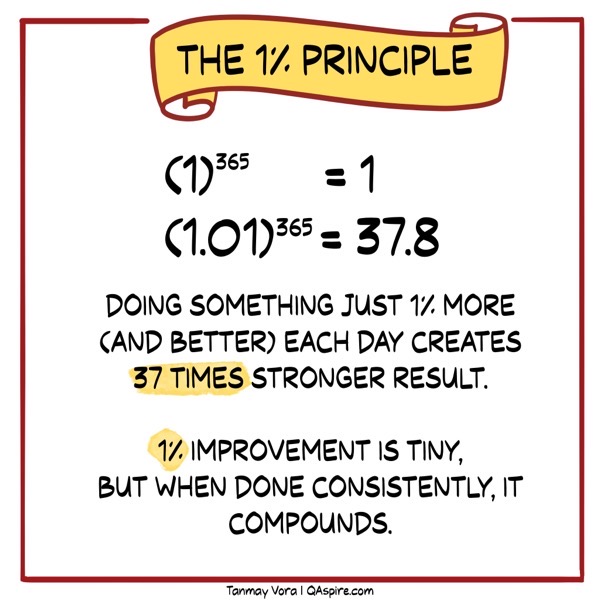
Tiny actions compound to create big results IF they are done consistently and improved upon.

“Success is a few simple disciplines, practiced every day; while failure is simply a few errors in judgment, repeated every day.” – Jim Rohn

Even Math proves it:

Key questions to ponder upon:

  • What areas in your life can benefit from improving just 1%?
  • What does that 1% improvement looks like?
  • Is that 1% smal enough to be sustainable?
  • Are you committed to really improve?

32/366

Focus on Your Circle of Control

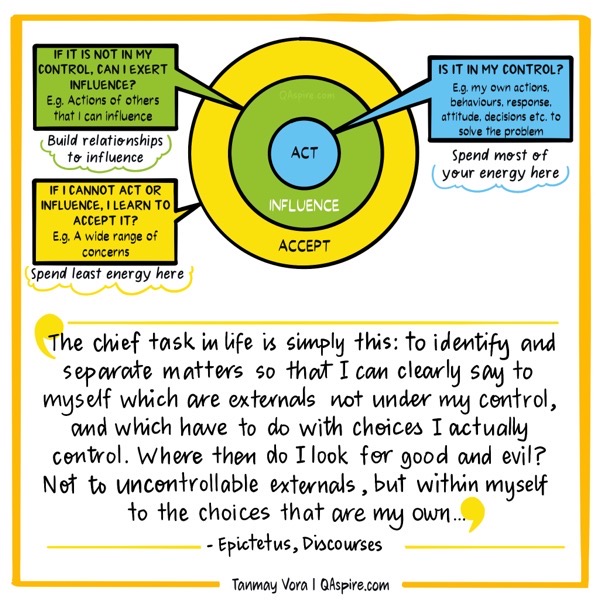
“The chief task in life is simply this: to identify and separate matters so that I can clearly say to myself which are externals not under my control, and which have to do with choices I actually control. Where then do I look for good and evil? Not to uncontrollable externals, but within myself to the choices that are my own.” – Epictetus, Discourses

32/366

Learn from Mistakes (of Others)

Life is too short to make all the mistakes yourself to be able to learn from them.

Therefore, carefully observe people around you, especially the ones who falter or take wrong decisions. Reflect on their mistakes, their decisions, their thinking patterns, their approach and their attitude. That awareness will educate you on how to avoid those mistakes. 

Our life becomes really simple even if we only know what NOT to do. 

31/366

Embrace Turbulence

You board a flight and it takes off. At that point, you are not expecting turbulence. 

But then, weather up there is uncertain. Turbulence is very much a possibility that pilots have to factor in when they take off. 

The problem with us is: We expect no turbulence when we plan our actions for the future.We love plans that are fixed and set in stone. We expect everything else out there to be consistent and constant. We expect that all our assumptions will turn out to be true. But they often don’t.  

So here is something worth remembering: Your plan is only your intention. Reality is that turbulence will happen.

In a constantly changing world, turbulence is our opportunity to adapt, innovate and learn new things. Expect it. Factor it in your plan. Build a mindset that helps you be agile. Turbulent weather often tests the skill and resilience of a pilot that a fair weather never can. 

Navigating through turbulence and finding your way out is a vital skill to build if you are taking the road less travelled to a worthwhile destination. 

30/366

Can/Should?

I can do all the administrative tasks of my business. That’s my ability.

But I outsource them to an accountant so that I can focus on my core business. That’s my choice. 

I can play a keyboard and a guitar. I learned it myself. I wanted do to more of it because I could. But at some point, I realized that I enjoy playing casually when I want to unwind. But I never aimed to be a music performer. So I can play music but I only play in leisure. Ability versus choice. 

Similarly, I can do a lot of other things. But that doesn’t mean I should do them all. Because that would mean spreading myself too thin. That would be attenuation of my energy, when what I really need is focus. 

To do more, you have to work on less (priorities).

So here’s my big lesson: Just because you can do something does not necessarily mean you should do it.

Exercise your choices wisely, for choices make up our lives.

“Don’t become a wandering generality. Be a meaningful specific.”― Zig Ziglar 

29/366

It’s later than you think

You work and work for years and years, you’re always on the go
You never take a minute off, too busy makin’ dough
Someday you say, you’ll have your fun, when you’re a millionaire
Imagine all the fun you’ll have in your old rockin’ chair

Enjoy yourself, it’s later than you think
Enjoy yourself, while you’re still in the pink
The years go by, as quickly as a wink
Enjoy yourself, enjoy yourself, it’s later than you think

– Guy Lombardo, Enjoy Yourself, It’s Later Than You Think

I loved this poem because it serves as reminder  that:

  • Life is too short to put off your dreams for later.
  • Never take the time you have for granted.
  • Making the most of time means spending it in making memories as much as in making money (that can help you make memories).
  • Never postpone when you really want to speak to your friends and loved ones. We all exist in limited time capsule.
  • Take time off regularly to recharge, reflect and make sense of it all.
  • It is never too late to start something new. 
  • There is no bigger waste than spending time on things that don’t matter (gossip, small talk, unproductive activities etc).

28/366

Communication Essentials

When I coach people in teams, I often ask an open ended question and let the other person speak. The less I speak, the more I can hear. 

In meetings, everyone wants to speak and express. I usually speak last or only after I have gathered my thoughts in mind. Speaking less, paradoxically, means you get heard. 

Thoughts have a tendency to flood our mind. Unless we practice, we will naturally speak at the speed of our thoughts. Which means, we will speak a lot. 

The key to learning, understanding and analysing a situation is to speak less. Let the signals come to you while you are attentively silent. 

And when you have to, speak clearly using less words. This takes practice but try to speak fewer words and shorter sentences without diluting the message. 

Paradoxically, when you do that, your messages become powerful. 

Finally, one of the most powerful ways to speak less is to speak slowly. Don’t rush your words. Take your time, pause between sentences, be calm and collected. 

Speaking slowly is a sign of confidence and clarity. Speaking only when you are prepared is a sign of cognitive maturity. Not speaking (and listening) when other person is speaking is a sign of empathy.

Do this and see your communication skills go to the next level. 

27/366