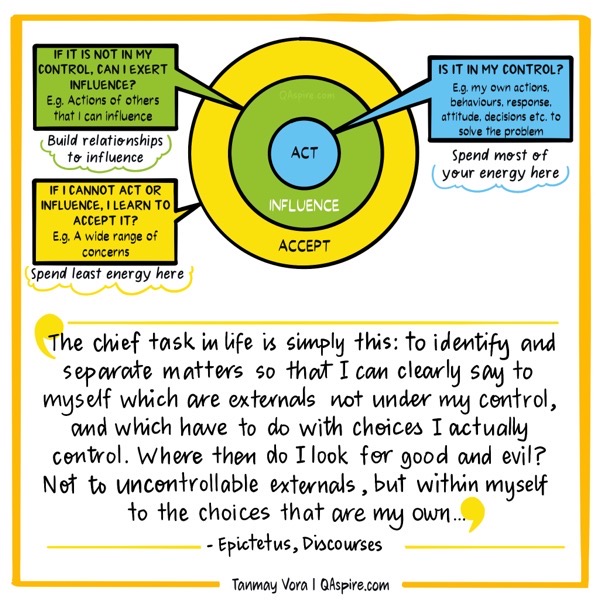
Focus on Your Circle of Control

“The chief task in life is simply this: to identify and separate matters so that I can clearly say to myself which are externals not under my control, and which have to do with choices I actually control. Where then do I look for good and evil? Not to uncontrollable externals, but within myself to the choices that are my own.” – Epictetus, Discourses

32/366

Learn from Mistakes (of Others)

Life is too short to make all the mistakes yourself to be able to learn from them.

Therefore, carefully observe people around you, especially the ones who falter or take wrong decisions. Reflect on their mistakes, their decisions, their thinking patterns, their approach and their attitude. That awareness will educate you on how to avoid those mistakes. 

Our life becomes really simple even if we only know what NOT to do. 

31/366

Embrace Turbulence

You board a flight and it takes off. At that point, you are not expecting turbulence. 

But then, weather up there is uncertain. Turbulence is very much a possibility that pilots have to factor in when they take off. 

The problem with us is: We expect no turbulence when we plan our actions for the future.We love plans that are fixed and set in stone. We expect everything else out there to be consistent and constant. We expect that all our assumptions will turn out to be true. But they often don’t.  

So here is something worth remembering: Your plan is only your intention. Reality is that turbulence will happen.

In a constantly changing world, turbulence is our opportunity to adapt, innovate and learn new things. Expect it. Factor it in your plan. Build a mindset that helps you be agile. Turbulent weather often tests the skill and resilience of a pilot that a fair weather never can. 

Navigating through turbulence and finding your way out is a vital skill to build if you are taking the road less travelled to a worthwhile destination. 

30/366

Can/Should?

I can do all the administrative tasks of my business. That’s my ability.

But I outsource them to an accountant so that I can focus on my core business. That’s my choice. 

I can play a keyboard and a guitar. I learned it myself. I wanted do to more of it because I could. But at some point, I realized that I enjoy playing casually when I want to unwind. But I never aimed to be a music performer. So I can play music but I only play in leisure. Ability versus choice. 

Similarly, I can do a lot of other things. But that doesn’t mean I should do them all. Because that would mean spreading myself too thin. That would be attenuation of my energy, when what I really need is focus. 

To do more, you have to work on less (priorities).

So here’s my big lesson: Just because you can do something does not necessarily mean you should do it.

Exercise your choices wisely, for choices make up our lives.

“Don’t become a wandering generality. Be a meaningful specific.”― Zig Ziglar 

29/366

It’s later than you think

You work and work for years and years, you’re always on the go
You never take a minute off, too busy makin’ dough
Someday you say, you’ll have your fun, when you’re a millionaire
Imagine all the fun you’ll have in your old rockin’ chair

Enjoy yourself, it’s later than you think
Enjoy yourself, while you’re still in the pink
The years go by, as quickly as a wink
Enjoy yourself, enjoy yourself, it’s later than you think

– Guy Lombardo, Enjoy Yourself, It’s Later Than You Think

I loved this poem because it serves as reminder  that:

  • Life is too short to put off your dreams for later.
  • Never take the time you have for granted.
  • Making the most of time means spending it in making memories as much as in making money (that can help you make memories).
  • Never postpone when you really want to speak to your friends and loved ones. We all exist in limited time capsule.
  • Take time off regularly to recharge, reflect and make sense of it all.
  • It is never too late to start something new. 
  • There is no bigger waste than spending time on things that don’t matter (gossip, small talk, unproductive activities etc).

28/366

Communication Essentials

When I coach people in teams, I often ask an open ended question and let the other person speak. The less I speak, the more I can hear. 

In meetings, everyone wants to speak and express. I usually speak last or only after I have gathered my thoughts in mind. Speaking less, paradoxically, means you get heard. 

Thoughts have a tendency to flood our mind. Unless we practice, we will naturally speak at the speed of our thoughts. Which means, we will speak a lot. 

The key to learning, understanding and analysing a situation is to speak less. Let the signals come to you while you are attentively silent. 

And when you have to, speak clearly using less words. This takes practice but try to speak fewer words and shorter sentences without diluting the message. 

Paradoxically, when you do that, your messages become powerful. 

Finally, one of the most powerful ways to speak less is to speak slowly. Don’t rush your words. Take your time, pause between sentences, be calm and collected. 

Speaking slowly is a sign of confidence and clarity. Speaking only when you are prepared is a sign of cognitive maturity. Not speaking (and listening) when other person is speaking is a sign of empathy.

Do this and see your communication skills go to the next level. 

27/366


Expand your horizons

There’s so much to know and so much to learn. 

And yet, we confine our selves to a limited set of knowledge that enables us to earn and pay our bills. That’s such a limited way of living a life that is unbound. 

With limited knowledge, we become prisoners of our own mind. 

My love for reading kicked in late in life. In fact, before internet, access to ideas was mainly through books and book access was limited.

It is only after 1998 that I started reading online. Internet brought out the keen learner in me. Through internet, I learned how to write. I learned how to code. I learned how to manage and lead teams. I learned how to sketchnote. I formed connections and relationships with people across the globe. The list is long.

Exposure precedes learning. To know that tremendous possibilities exists is the starting point of deciding what to focus your energies on.

So, get exposed to a variety of ideas. Read good books (they’re easily accessible now). Write down your thoughts. Meet diverse people. Have deep and wide conversations. Take notes. Expose your mind to diverse thoughts, perspectives and information. Go wide, when it comes to acquiring understanding.

As you read more, you will realize how interconnected everything is. That understanding and breadth enables you to see things, to notice gaps and find opportunities. With the breadth of understanding, you are likely to find resonance with other people across the globe.

We live in times when learning something is easier than ever before. It is not the resources that are scarce, it is our ability to step out of our mind and explore the world around us that is. 

Content follows intent. 

26/366
Anti-Goals

When we set goals, we think about desirable outcomes. I want to score x%, I want to make Y$, I want to travel to Z destination. 

When we set anti-goals, we turn this process around. We think of undesirable outcomes and think of “anti-goals” as activities, systems and actions that will allow us to avoid those undesirable outcomes. 

Anti-goals and goals are two sides of the same coin. Your goals should be generative and protective as well. Anti-goals are protective in nature.

For example, your goal is to run a successful business that employs 100’s of people. That’s a worthy goal. But to do that, you need to avoid being sick, you need to avoid running out of money or make stupid investment decisions that drains your business away. Setting up systems and processes that don’t let you fail are as important as creating systems that enable you to succeed. 

Throughout my career, I have worked in processes where risks were assessed and mitigation actions were planned to avoid and manage those risks. Fortunately, I was also able to bring those principles to how I managed my career and finances. For instance, I never fell for get-rich-quick schemes where risk outweighs the benefits. I was always mindful about my investments balancing stable returns with volatile ones.

Setting up systems to achieve anti-goals over a long period of times ensures you don’t be stupid and lose out on your gains.  

Charlie Munger, the most famous investing partner of Warren Buffet got it right when he said,

It is remarkable how much long-term advantage people like us have gotten by trying to be consistently not stupid, instead of trying to be very intelligent.

25/366

What needs to change?

Albert Einstein famously said, “Insanity is doing the same thing over and over again and expecting different results.” 

If you are not happy with how things are, ask the following questions:

  • What am I not happy with?
  • Why am I not happy with? 
  • What do I expect should happen?
  • Why is it not happening?
  • What can I do differently so that it happens?

That last question can have answers about your process, your methods, your approach, your attitude, your ability to execute or your ability to collaborate with others. 

Depending on the problem you are trying to solve, the answers would vary. 

The real value is in asking the questions and striving to improve.

24/366

Stress is your friend

They say, only dead people have no stress. Some degree of stress that comes with doing anything worthwhile is actually a friend that pushes you to be alert, do your best and deliver.

Stress only becomes chronic when it is continuous and unmanaged. 

Our job as aspirers is not to avoid stress or take decisions based on anticipated stress – that’s lazy thinking. 

Our job is to leverage stress, channel that energy and do the work that matters. 

The key to that is ability to manage stress regularly.

How do we do that?

  • Sleep is #1 antidote to stress. A good night’s sleep provides us energy and fresh perspectives.
  • Reframe stress as a friend and not a foe.
  • Take micro-breaks – go for a walk, talk to someone, listen to a song, have a coffee, gaze at distant trees for 30 seconds. You get the point.
  • Write down your thoughts, plans and tasks. Keeping it all in the head leads to stress.
  • Be physically active and eat healthy. A fit body enables you to confront stress more effectively.
  • Talk to others. Having people around you who can help you wade through choppy waters is vital.
  • Set healthy boundaries. Say no to things, thoughts or people who wear you down.
  • Act. Do the thing. Thinking too much creates anticipatory stress. Confront what is in front of you. Take action.
  • Stay focused on the outcome you wish to achieve. Seeing big picture helps you put things in perspective.

“The greatest weapon against stress is our ability to choose one thought over another.” – William James

23/366