Goals, Mindset and Attitude

Setting goals is important. However, goals are temporary and short-lived. They change based on change in our situation, aspirations, life stage and circumstances.

Goals are simply milestones along the road. They come and go. 

What does not change is your mindset and attitude. Mindset is how you see the world around you. Mindset is about the journey not just about the milestones. 

Mindset is the lens through which you see the world. If you keep your mindset positive and learning oriented, you can go through the most difficult situations in life and still learn from them. It is about seeing the glass half full and having curiosity to understand situations and people. 

Attitude is what you do with what you see. Mindset instructs attitude and is reflected in your actions.

If your mindset is constrained, you will run away from problems because you see them in negative light.

If your mindset is abundant, you will stay with the problem, understand it and see it as an opportunity to learn and solve.  

Talent only opens the door for you. Greatness happens when talent meets right attitude. 

Here is an old video of Harsha Bhogle giving a talk at Ahmedabad Management Association, which underlines the relationship of talent and attitude so well.

9/366


The Arms Race

This happens all around us: People try to keep up with what others are doing. This race to be compliant to the larger expectation is also called “the arms race phenomenon” – people will race towards getting the arms (just like countries do) that everyone else has. The “arms” here could be that fancy college degree, palatial house, that attractive SUV, social media followers etc. You get the point.  

When I behave a certain way just because everyone else seems to be doing it, I am participating in the “arms race”.

The best example of this is our education system. Knowing that IIT pass outs earn a higher starting salary, millions of students race towards availing expensive coaching. Same applies to getting into medicine and other seemingly lucrative career paths. Who benefits more – a few students who clear these hurdles or the expensive coaching institutions? 

In his 2015 New Yorker article titled “College Calculus”, John Cassidy writes,

If almost everybody has a college degree, getting one doesn’t differentiate you from the pack. To get the job you want, you might have to go to a fancy (and expensive) college, or get a higher degree. Education turns into an arms race, which primarily benefits the arms manufacturers—in this case, colleges and universities.

Rolf Dobelli offers excellent suggestion in his book “The Art of the Good Life”

“Try to find a field of activity not beset by the arms race… Retreat every so often from the field of battle and observe it from the above. Don’t fall victim to the madness… You will only find a good life when people aren’t fighting over it.”

Key questions to ask yourself:

  • In what activities of my life am I trying to do something just because everyone else seems to be doing it?
  • What can I do to escape the arms race so that I can truly work in areas I am truly passionate about?
  • If I am in the arms race, does it truly align with my ambitions, my values and my inherent skills as a person?
  • If I am in the arms race, how can I leverage my strengths to be in the top 10% bracket in the race?
  • What can I do to find a niche where I can differentiate myself uniquely? (How can I start an arms race

Escaping the arms race is not same as being lazy or less hard working. It is about choosing a different path, not a conventional one. It is about applying what you learn rapidly (even when you are in a full time course) rather than waiting for education to get over. 

The real education is in doing the stuff and learn by doing.

8/366

Listen to What Comes from Within


Best things cannot be bought, they come from within.

You can buy bestselling books or work hard to get into ivy league institutions hoping to learn, but passion to learn cannot be bought, it comes from within.

You can buy an expensive house, but contentment comes from within. 

You can socialise and make many friends, but resonance with others comes from within.

You can earn as much as you wish to, but the feeling of “enough” comes from within.

You can listen to a movitational speaker, but real motivation comes from within.

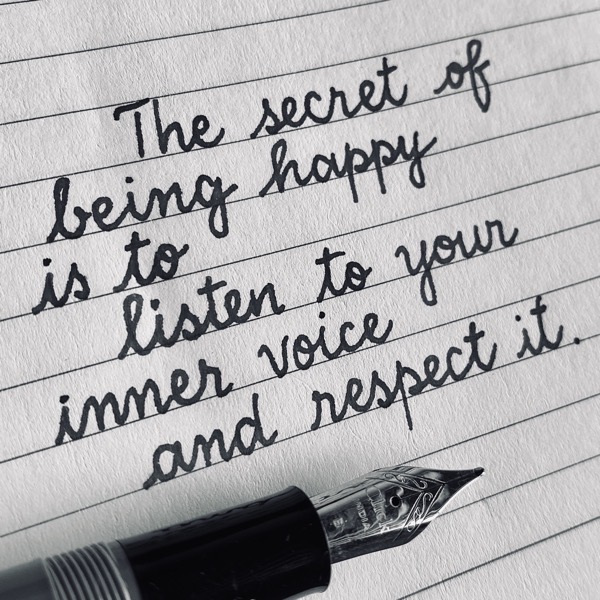
The secret of being happy is to listen to your inner voice and respect that. Inversely, the recipe of unhappiness is to ignore these signals (that are often quiet, subtle and easy to miss) and act according to the outer world’s expectations of success. 

The thing is: Your inner voice is heard clearly when you are at peace, not when you are in an anxious and analytical state. 

7/366

The Art of Restart

The journey of building a good life is fraught with road blocks, failures and seemingly long roads that take you nowhere. 

When you encounter any of these, which you definitely will, remember: You can always RESTART.

When a computer system got slow, our IT team would always ask us to restart it. That often solved the problem. Restarting works as well for humans as for machines.

I had to take a pause during my most formative years when I struggled to find what I really wanted to do. Pausing and thinking about what I really wanted to do enabled me to choose a career in information technology. Two years into it, I was laid off due to recession. I was forced to restart the journey and initiate my own business. After few years in business, I decided to gain corporate exposure and that meant restarting into an entry level job and strive to move up the corporate ladder. I worked my way up by taking up diverse and global roles, many of which included doing things that I had NEVER done before. These restarts were supported by bosses and teams I worked with. When I reached the corporate peak leading 680+ people, I had a lot of comfort which was discomforting. Life priorities and lack of challenges led me to restart again and start my own consulting business – this time with 22+ years of experience and diverse skills under my belt. I am pretty sure I will continue this journey of restarting in future as well.

Restarting is not about erasing the past; it means learning from it to create a better future.

Life, after all, is a journey of never-ending new beginnings. In fact, doing things that you have never done before is how we grow and evolve. Seth Godin asks a very pretinent question, “When was the last time you did something for the first time?”

Restarting is not easy. It requires you to:

  • Be self-aware about your intrinsic skills, needs and desires
  • Take a pause and think through the inventory of what you have, what you want to do with what you have and what difference you wish to make in the world.
  • Give up on the fear of failure to embrace the unknown
  • Be comfortable with the ambiguity and uncertainty that comes with working in new domains and with new people solving new kinds of problems
  • Unlearn and let go of your preconceived beliefs about how things should work
  • Learn at the speed of change, be adaptable and respond to changing and challenging situations with agility
  • Give up on your need to be on a stable ground and be willing to step into uncharted territories (which might include moving places, mindset and industries)
  • Let go of your ego, and the need to be seen by others as successful
  • Ask for help from others when needed to accomplish what you have set out for
  • Build a network and be a part of newer communities around your interests
  • Take regular pauses to reflect and put your learning from last step into the next one

 Being able to restart is a super power in an uncertain world. It is almost like setting the dried weeds on fire so that you can uncover the fertile ground rich with possibilities and untapped potential.  

6/366

“How Much” or “How Well”

The famous violinist Nathan Milstein wrote: “Practice as much as you feel you can accomplish with concentration. Once when I became concerned because others around me practiced all day long, I asked [my mentor] Professor Auer how many hours I should practice, and he said, ‘It really doesn’t matter how long. If you practice with your fingers, no amount is enough. If you practice with your head, two hours is plenty.’”

“How much” you do is almost never as important as “how well” you do it. 

“The definition of insanity is doing the same thing over and over again and expecting different outcomes.” – Einstein

5/366

Deliberate Practice

Writing a blog for over 16 years is a deliberate practice. 

Working out several times a week is deliberate practice.

Creating sketchnotes consistently for 8+ years is a deliberate practice.

Keeping track of my financials with a goal to be debt free was a deliberate practice.

Before we delve into the mechanics of deliberate practice, consider this recent example:

In May of 2023, I hit a wall. I had elevated blood sugar level. My dad’s by-pass surgery and growing a new business added to my stress and anxiety. I had to do something about it.

I broke my need to improve health into a few areas:

  1. Stop the damage through medicines and immediate lifestyle changes
  2. Join a Diabetes reversal program that came with nutritional guidance, medical guidance and a continuous glucose monitor attached to my bloodstream.
  3. Getting a gym membership
  4. Committing to better sleep schedule (which in turn would manage stress as well)

These were the first steps, but I needed to be consistent at following the lifestyle changes in the weeks/months to come.

Deliberate practice is about being disciplined and intentional. I got a few sheets of paper, drew columns and started tracking a few essentials:

  • Diet intake (simple pen and paper journal of eating pattern that was required for CGM)
  • Exercise (day wise exercise minutes,  active calories burn, workout type etc). My Apple watch measured it all, but the act of writing the vitals elevated my consciousness. 
  • Sleep (sleep timing, restful sleep, sleeping heart rate etc)

Writing these simple things on a piece of paper became my end-of-the-day ritual that kept me focused and conscious.

Knowing I missed a few days at gym encouraged me to go. Seeing myself going off track with diet brought me back to being disciplined. I avoided taking late night work calls so that I could sleep on time. All this because I was accountable to a piece of paper. I was able to notice the patterns and course-correct my actions accordingly. 

CGM was taken off in two weeks but this practice of writing and journaling continued for three months. These actions, that seemed to weigh me down initially, started becoming a habit. Any significant improvement will always come with some degree of discomfort initially. In fact, you have to step out of your comfort zone if you want to learn anything new. 

When habits are formed (i.e. acting without being conscious about it), you no longer need to write. Moreover, jounaling could be something as simple as a checklist of activities/behaviors that you can tick off at the end each day.

“Whatever you pay attention to develops.”

The process worked. My blood sugar markers returned to normal and medicines were gradually reduced and then stopped. 

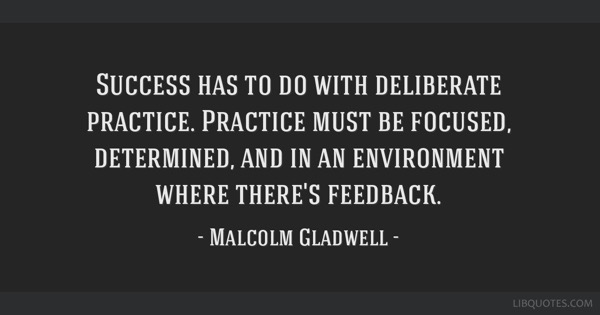
Deliberate practice is deliberating (thinking) on our practices (behaviours/actions) with focus on improvement. High-performing atheletes/professionals do this all the time. High-performing organizations measure right things. We should be no different. 
It is about being intentional and systematic about improvement through:

  • Breaking down the overall process into parts
  • Knowing what needs improvement within those parts
  • Creating a system (including coaching if required) to track improvement and be accountable  
  • Active and conscious pursuit of improvement through right actions
  • Jounaling/measuring to see the progress, notice behavioral patterns and building accountability to yourself
  • Aligning your actions based on feedback from metrics, patterns and what you learn from it.
  • Repeating and improving until repetitive behavior becomes a habit.

If you want to raise your consciousness about anything you wish to improve upon, try practicing it deliberately. It works!

4/366
Gratitude Unlocks the Fullness of Life (2/366)

As a kid, I once compared my belongings with that of my richer friends. When I once complained about it, my mom took me to the balcony to guide my attention to a construction site nearby. The kids of labourers barely had clothes on their bodies but were happily playing in the heap of sand. A lesson for the lifetime was learned – that I can never be happy if I am not grateful about the blessings I already have. What we have today may be a dream for someone else.

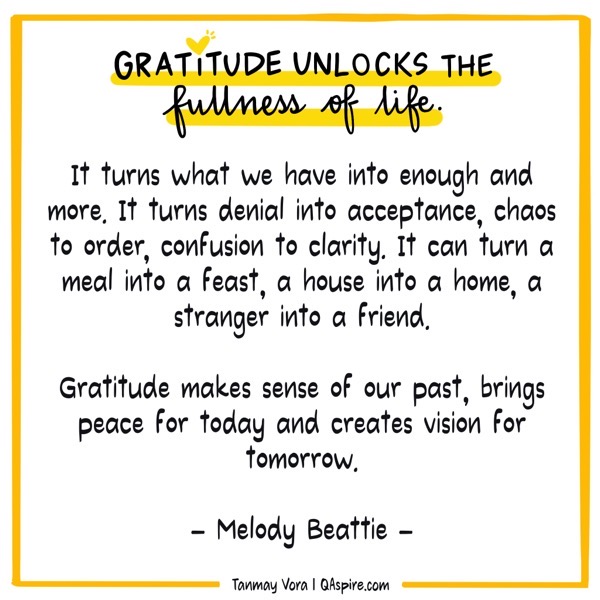
Love the following quote from American author Melody Beattie,

Waking Up to First Day of the Year (1/366)

New year’s eve was a simple family affair. The day was filled with love, laughter and good food with family. As the clock ticked closer to 12AM, we sat together anticipating fireworks around us before calling it a day. That wait felt longer as it always does when you anticipate anything. 

Kids started reflecting on 2023 which, for them, was mostly about their academic and extra-curricular pursuits. Interestingly, one of the high-points for my 11 yrs old son was getting a set of acrylic markers for his artistic endeavors! Kids revel in small joys of life that we grown-ups often take for granted. We took turns to look back at 2023 and express what we hope for in 2024. It is a powerful family exercise that I recommend we should do several times in a year. Collective expression of hopes, desires and fears only strengthens the bond we share.

At the end of it with just 5 minutes to go, one thing was clear. We were deeply grateful for everything 2023 had to offer. Despite all challenges including life threatening medical situations in the family, we were grateful for the strength we received to handle it all with grace, calm and a stoic focus on our circle of action. As they say, “All’s well that ends well.”

“The chief task in life is simply this: to identify and separate matters so that I can clearly say to myself which are externals not under my control, and which have to do with choices I actually control. Where then do I look for good and evil? Not to uncontrollable externals, but within myself to the choices that are my own..” – Epictetus, Discourses 

Calm optimism and gratitude fills the air around me on the first day of 2024. That’s what a new year does to us. A new dawn that brings 366 fresh opportunities (thanks to a leap year) to embrace new experiences, follow your heart’s path and be kind to others along the way. A blank slate to write the story our heart yearns to write.

Wishing you a joyful, abundant and glorious 2024! 

A New You, Anytime of the Year

Why wait for a new year to commit to being your better self and set goals/resolutions.

Dividing time into years and months is a construct created by us humans.

Remember: You can reinvent yourself any time you decide to. If anything is worth doing, it is worth doing it now.

Inner Boundaries

I played cricket after a really long time through participation in my neighborhood’s premier league. The opponent teams had players far younger than me with prowess to throw high-speed deliveries. The first couple of matches were really hard. I could barely guard the wicket for a ball or two before getting bowled out.

Third match was a turn-around. Before the match, I affirmed myself with the following:

You get bowled out, not by an opponent’s speed of bowling, but by your internal anxiety to perform. Let it go, calm down, watch the ball carefully and play it according to it’s merit. Defend good deliveries (read tough times) and wait for the loose ones (read opportunities) to take your chances. Let go of your need to show your performance and score runs. Focus instead on each ball, it’s trajectory, pitching and length before doing justice to it. Score can just be an outcome of your ability to enjoy the game.

In that match, I hit five boundaries and everyone around was amazed. The big lesson for me is: It’s always about conquering ourselves first before we can conquer anything in the outer world.

Seneca rightly said,

“A rational soul is stronger than any kind of fortune – from its own share, it guides its affairs here or there, and is itself the cause of a happy or miserable life.”

Ability to stitch yourself together when situations tear you apart is a life skill that no one teaches. We have to do it ourselves. Strengthening the soul is the work of our life.

We are in semi-finals as I write this. Outcome will not matter knowing that I crossed a few inner boundaries!